
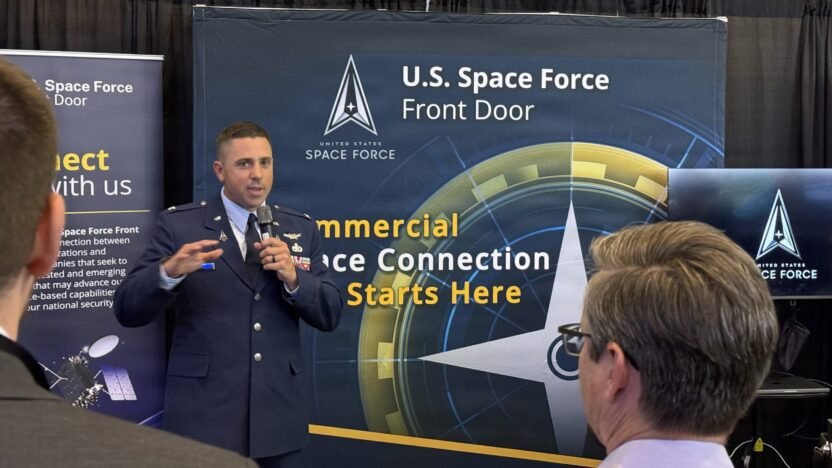
WASHINGTON — As investment pours into defense and space startups, the U.S. Space Force is trying to draw more of those companies into the national security market.
After hundreds of startup pitches, the head of the Space Force’s commercial office offers a candid assessment of what companies get right — and wrong — when approaching government buyers.
Speaking May 27 at the State of the Space Industrial Base conference hosted by NewSpace Nexus in New Mexico, Col. Tim Trimailo shared what he described as personal observations from those interactions. His central message for startups: Build something that solves a real problem. Explain why it matters. Be candid about what has gone wrong. Understand how government buying works. Keep commercial customers in the picture.
“Start with the ‘why’ … Why do we need it? Tell the story,” Trimailo said. “We have some founders who jump in, and they are incredibly intelligent. They understand their technology better than anybody else, but you have to start with the story. Why is your technology important? What capability does it deliver to the warfighter? Start there.”
The advice reflects a broader tension playing out across the defense space sector. Venture funding has poured into companies developing satellites, communications networks, software, sensors and other systems, many of them built around the expectation that military demand will grow. Yet converting technical promise into government contracts remains one of the industry’s biggest challenges.
Trimailo’s comments suggest that the obstacle is not always a lack of innovation. Sometimes it is a failure to connect innovation to military outcomes.
The Space Force, he said, is buying capability, not individual components.
“We buy capability, we don’t buy widgets,” Trimailo said. A propulsion system, communications terminal or other subsystem may be impressive on its own, but companies need to show how it contributes to a larger operational capability. “We have to see the ‘so what.’”
Just as important is transparency.
The commercial space industry has experienced its share of technical setbacks, launch failures and underperforming satellites. Trimailo argued that companies often do themselves a disservice by trying to hide those problems from government customers.
“This is a small ecosystem,” he said. “We all sort of know what’s going on behind the scenes.” If a spacecraft reaches orbit but does not perform as expected, the better approach is to explain what happened and how the company plans to fix it. Setbacks themselves are not disqualifying, he said. The response to those setbacks often matters more.
That desire for openness extends to discussions about proprietary technology.
Trimailo said some founders are willing to explain the value of their products but become guarded when officials ask detailed follow-up questions about performance or technical differentiation. While companies do not need to disclose every trade secret, they must provide enough information for government evaluators to assess whether the claims are credible.
“Give us a peek behind the curtain,” he said. “You don’t have to share all the secret sauce, but you have to at least give us a glimpse, so we can hit the ‘I believe’ button and trust that what you’re telling us is true.”
‘No secret pots of money’
Trimailo’s advice also reveals a persistent misunderstanding between startups and the Pentagon acquisition system.
Many companies arrive expecting hidden pools of funding or rapid procurement pathways. Trimailo warned that such opportunities are rare.
“There are very, very few, if any, secret pots of funding across the Space Force to go deploy into commercial technologies,” he said. Instead, companies need to understand how budgets are built, where requirements originate and which organizations actually control funding. The best way to learn, he said, is often simply to ask questions.
Patience is another prerequisite.
The defense market is notorious for long timelines, shifting priorities and organizational complexity. Program offices operate under different cultures, funding constraints and acquisition approaches. Companies that succeed tend to maintain engagement over time rather than treating a single meeting as a make-or-break event.
“Persistent engagement is really the name of the game,” Trimailo said.
Perhaps his strongest warning concerned the temptation to become overly dependent on government business.
As defense spending on space grows, some startups have begun tailoring products specifically for military customers. Trimailo cautioned against abandoning commercial markets in pursuit of perfect alignment with government requirements.
“It would be a shame if we met with all these commercial companies, and at the end of the day, the end result was we changed what made them commercial from the starting point,” he said. If a product already satisfies most of the government’s needs, companies should be careful about redesigning it solely to capture the final 20% of a requirement. “Don’t let us throw you off your mark.”
That philosophy reflects a growing consensus within parts of the Space Force that commercial innovation is most valuable when it remains commercially viable. A healthy commercial customer base can reduce government development costs, attract outside investment and provide evidence that a technology has broader market relevance.
That dynamic is visible in how startups finance growth, said Trimailo.
He described successful companies as moving back and forth between government and private funding, using each to unlock the other. A company might win an initial Small Business Innovation Research, or SBIR, award, then use that government backing to attract venture capital. The resulting private investment can in turn strengthen the company’s case for additional government funding through programs such as Tactical Funding Increase (TACFI) and Strategic Funding Increase (STRATFI).
“We want to see dual-use capabilities, we want to see other people paying down some of our R&D bills,” Trimailo said. The strongest performers are often those that combine private capital and government funding in a deliberate sequence as they move through development.