VENICE, Italy — China continued its accelerated launch pace with a series of missions, but long silence followed liftoff of a Kuaizhou-11 solid rocket Wednesday, suggesting potential issues.
The Kuaizhou-11 solid rocket lifted off at around 11:40 p.m. (0340 UTC) from Jiuquan Satellite Launch Center in the Gobi Desert. While Chinese social media posts indicated launch had occurred, silence followed for a number of hours. Such silence usually presages a launch failure, or problems with one or more payloads. At time of reporting, more than eight hours had passed since liftoff without official word on the mission.
The Kuaizhou-11 is a larger version of Expace’s Kuaizhou-1A. Its first launch in July 2020 ended in failure. It launched three times successfully since then, most recently a rideshare mission in March this year. A launch failure, if confirmed, would not have a profound impact on China’s launch plans, given Expace’s supplementary role in the country’s launch capabilities.
Long March 12 carries Guowang satellites to orbit
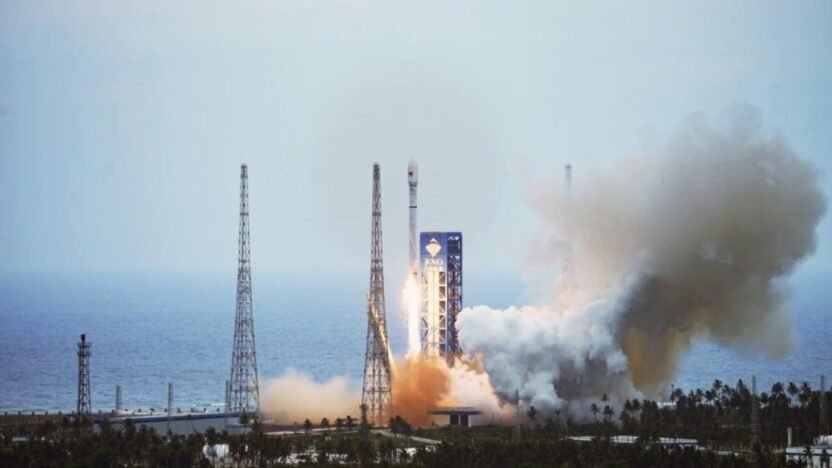
The Kuaizhou-11 mission followed shortly after a Long March 12 expendable rocket launch at 10:44 p.m. Eastern (0244 UTC, June 17) from Hainan Commercial Space Launch Site. The China Aerospace Science and Technology Corporation (CASC) confirmed launch success, describing the payloads as the 22nd group of satellite internet low-Earth orbit satellites, correlating to the national Guowang broadband constellation.
Four previous Long March 12 launches carried nine satellites each for Guowang. Based on this pattern, there are now 177 Guowang satellites in orbit for the 13,000-satellite program.
The Long March 12 has now launched six times, with its debut flight in November 2024, and uses a horizontal assembly, test, and transport processing mode. It is rated for at least 12,000 kilograms to low Earth orbit (LEO) and 6,000 kg to 700-km sun-synchronous orbit (SSO).
Shijian-31 heads for GEO
Prior to the June 17 launches, a Long March 3B lifted off at 5: 45 a.m. (0945 UTC) Tuesday, June 16, this time from Xichang Satellite Launch Center in southwest China.
CASC confirmed the success of the launch, revealing the payload to be Shijian-31. The satellite will be “mainly used for space environment exploration,” according to CASC, with no further information provided on the spacecraft and its mission, as is typical for the Shijian satellites. The Shijian series is often associated with experimental and demonstration missions, including on-orbit refueling tests.
The launch was a return-to-flight for the Long March 3B, a workhorse for launches to geostationary transfer orbit, which suffered a failure Jan. 16 following a third stage anomaly. The failure had knock-on effects for the 3B and the newer Long March 7A, which inherited the hydrolox 3B third stage.
Jilin-1 expands with Kinetica-1 launch
The cluster of launches kicked off with a CAS Space Kinetica-1 solid rocket launch last June 14 Eastern. Also known as Lijian-1, liftoff occurred at 11:44 p.m. (0344 UTC, June 15) from Dongfeng Commercial Aerospace Innovation Test Zone at Jiuquan.
The launch successfully inserted eight satellites into orbit for remote sensing constellation operator Changguang Satellite, a commercial firm spun out from the Chinese Academy of Sciences’ CIOMP in Jilin province.
The satellites were designated Jilin-1 Gaofen 04D01 and 02, Jilin-1 Gaofen 05D01 and 02, Jilin-1 Gaofen 07C04, and Jilin-1 Gaofen 07D02-04, with a number featuring branding names in addition.
Wenwu-01 (Jilin-1 Gaofen 04D01) is a dedicated high-resolution optical Earth observation satellite built jointly with the National Cultural Heritage Administration for systematic monitoring and enforcement oversight of cultural heritage sites, according to a Changguang Satellite post containing first images. Jilin-1 Gaofen-07C04 is described as featuring on-board deep fusion processing, autonomous mission planning, on-orbit AI algorithm updates, and sub-0.5m resolution.
“Kinetica-1 is now the first vehicle from a private Chinese launch provider to launch 100 satellites, CAS Space claimed in a post on X. The rocket has now launched 14 times, with the 15th recently completed assembly and testing, and will launch five satellites in the near future, according to CAS Space.
China launch record
The launches take China’s launch attempts so far this year to 43, including three failures (with the Kuaizhou-11 launch status unknown), and were the country’s ninth launches in the month of June alone. One of these, a Zhuque-2E launch of direct-to-device test satellites, saw the upper stage breakup in orbit June 9, the same day as launch, U.S. Space Forces – Space (S4S) confirmed. The rocket body was tracked at 424 by 335 kilometers, meaning while a threat to spacecraft, most of the debris will be relatively short-lived in orbit.
China is understood to be aiming to surpass the 100 launch mark for a calendar year for the first time in 2026, while also debuting potentially reusable launchers with much greater payload capacity than most existing rockets. Launches planned for the near future include a Long March 7A rocket from Wenchang June 23, and a Long March 8A from the nearby Hainan commercial space launch center June 27.