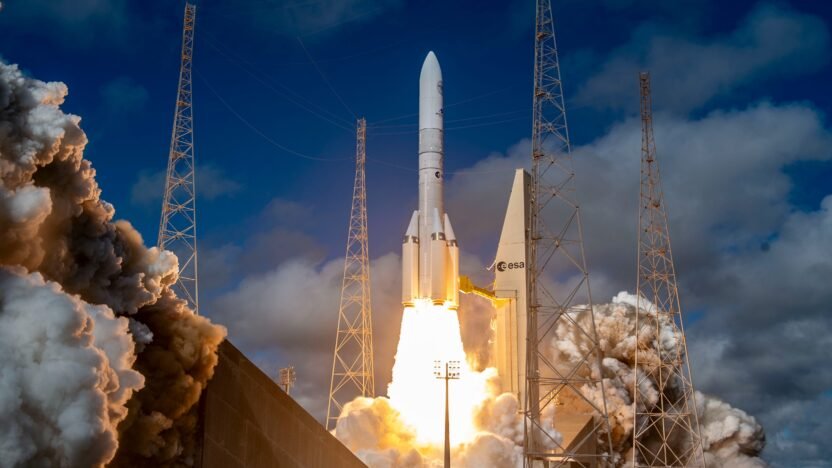
WASHINGTON — An Ariane 6 with upgraded solid rocket boosters successfully launched three dozen Amazon Leo satellites June 17 as ESA weighs options for increasing the vehicle’s launch rate.
The Ariane 64 rocket lifted off from the European spaceport at Kourou, French Guiana, at 8:21 a.m. Eastern. The liftoff was delayed by about a half-hour because of an unspecified issue detected about a minute before the planned liftoff.
The rocket carried 36 Amazon Leo broadband satellites that were deployed by the Ariane 6 upper stage into low Earth orbit starting 1 hour and 26 minutes after liftoff. The satellite deployments were completed 25 minutes later.
The mission, designated VA269 by Arianespace and LE-03 by Amazon, was the third Ariane 6 launch this year, all for Amazon. It was the first, though, to use upgraded P160C solid rocket boosters. Those boosters provide increased thrust compared with the P120C boosters used on previous Ariane 6 launches, increasing the rocket’s payload capacity to LEO by more than two metric tons.
That allowed this mission to carry 36 Amazon Leo satellites, whereas the prior launches in February and April each carried 32. That is the most Amazon Leo satellites on a single launch to date, including Atlas 5 and Falcon 9 missions, and the payload is the heaviest launched on an Ariane 6.
“With 100 satellites now placed in orbit by Arianespace for Amazon Leo and the launch of four more satellites than the first two missions, we are setting records with an increasingly powerful and versatile launcher,” David Cavaillolès, chief executive of Arianespace, said in a statement after the launch. “This further demonstrates our ability to address new markets, and especially constellation deployment.”
The launch is the third of 18 that Amazon ordered from Arianespace in 2022. It has become an important vehicle for the deployment of Amazon Leo given delays and anomalies with Blue Origin’s New Glenn and United Launch Alliance’s Vulcan Centaur, two other vehicles with large launch contracts for the 3,636-satellite constellation.
So far, 367 Amazon Leo satellites have launched on Ariane 6, Atlas V and Falcon 9. However, there is only one more Atlas 5 launch for Amazon Leo, scheduled for July 3, forcing Amazon to lean more on Arianespace.
“As far as Arianespace, for sure, they definitely have stepped up,” Steve Metayer, vice president of Amazon Leo production operations, said in a call with reporters before the launch.
“They’re very reliable on their manifest dates. They’re very reliable and safe on their insertions in orbit,” he said. “So, we definitely would continue to look forward to the next 16 launches with them on our existing contract, and we see them being a player long term beyond that.”
He downplayed the impact of the New Glenn pad explosion on the deployment of the constellation, noting that the vehicle accounts for less than 25% of the total launches under contract. However, each New Glenn launch will carry at least 48 Amazon Leo satellites, more than other vehicles.
Amazon does have less schedule pressure to deploy the constellation. The Federal Communications Commission issued a waiver June 5 of the milestone Amazon had in its license to deploy half of the constellation by July 30. The company still has a July 2029 deadline to deploy the full constellation and, as part of the FCC’s waiver decision, Amazon temporarily lost priority to some spectrum.
In the prelaunch briefing, Amazon and Arianespace did not rule out fitting more Amazon Leo satellites on future Ariane 6 launches. ULA, for example, was able to increase the payload on Atlas V launches from 27 to 29 satellites through engineering work and use of a higher-performance version of the RL10C engine in the rocket’s Centaur upper stage.
“The more we launch, the better we know the launcher,” said Cavaillolès. “We already are looking at further improvement, so we’ll do our best to keep increasing the performance of the launcher and thus the number of satellites we can carry for each launch.”
That includes, he said, a lighter version of the Ariane 6 upper stage. “Basically any means that could enable us to lighten the launcher and to free more performance, we’ll study it.”
“We definitely take as much performance out of the rockets and put as many satellites in as we can,” said Metayer.
Increasing launch cadence
This was the third Ariane 6 launch of the year. Cavaillolès said in January the company expected seven or eight launches this year for both government and commercial customers.
Arianespace expects to reach a peak launch rate of nine to 10 missions a year in 2027. The company had been reticent to try to expand beyond that, citing the need to make significant infrastructure investments, like increased production of boosters and additional launch processing facilities, to support a higher launch rate.
Last September, Cavaillolès said the company was “reopening the case” for a higher launch rate because of increased institutional demand from European governments and the potential for additional commercial satellite constellations. He said the company needed to decide by 2027 whether to pursue upgrades to be ready when that demand emerges at the end of the decade.
“If we think that, around 2029 or 2030, we need a higher cadence, then it is next year or the year after next that we should make the decision,” he said then.
There could be support from the European Space Agency for any infrastructure improvements needed for increasing the Ariane 6 launch cadence, said Josef Aschbacher, ESA’s director general, at a June 17 briefing after a meeting of the ESA Council in Paris.
“We have assessed the needs, roughly speaking, using planning figures from the various satellite constellation builders and developers,” he said. “Now we need to put this together and see what this means in terms of budgets, funding and so on.”
He said ESA was looking at scenarios of 12, 15 or 20 Ariane 6 launches a year to determine what infrastructure upgrades would be needed. “They have different price tags and different implementation schedules,” he said, but he did not offer any details on those costs and schedules.
Aschbacher added that ESA was also looking at increasing the cadence of Vega C launches as well as those by the four startups that secured funding last year in the European Launcher Challenge: Isar Aerospace, MaiaSpace, PLD Space and Rocket Factory Augsburg. The European Commission is also considering its own support for European launchers, but that likely would not come until the commission’s next financial cycle begins in 2028.
“We expect clarity certainly before the end of this year” on how ESA might support an increased Ariane 6 launch cadence, he said. That might come at an interim ministerial conference meeting planned for mid-December in Rome.
Jason Rainbow contributed to this article.