
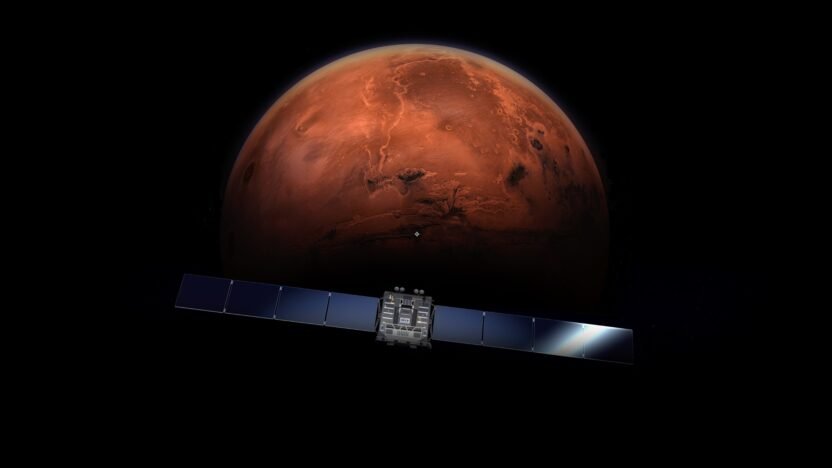
WASHINGTON — Relativity Space plans to launch a Mars orbiter in 2028 as part of a new initiative to privately develop planetary missions.
The company announced June 17 its Interplanetary Sciences Program, which it described in a statement as “an initiative to enable radically more science per dollar by building the next generation of interplanetary capabilities that make scientific discovery more capable and accessible.”
The program will support science missions that will also “develop and fly foundational technologies and payloads” to support research goals, the company stated, working in partnership with industry, academia, philanthropic organizations and NASA.
The first of those missions is a Mars science and telecommunications orbiter mission planned for late 2028. The payload will include an atmospheric profiling instrument suite contributed by NASA’s Ames Research Center and a radar instrument to map subsurface ice and geology.
The spacecraft will also serve as a communications node, providing high-bandwidth laser and radio-frequency links to Earth as well as radio-frequency communications with spacecraft on the Martian surface. Relativity said the spacecraft will also offer “massive” data storage and “server-class compute” that could be used for artificial intelligence models and autonomous operations.
Relativity did not provide technical details about the spacecraft, such as size, mass or power. The inclusion of a radar instrument and its computing and communications capabilities does suggest relatively high power requirements, which would affect its size and mass.
The mission would launch on the company’s Terran R reusable launch vehicle, which has been under development for several years. The company did not disclose how much it is spending on the mission, but a source familiar with the company’s plans said Relativity is working with an undisclosed philanthropic organization to fund it.
The Mars orbiter mission is intended to be a proof of concept for later missions in the company’s Interplanetary Sciences Program, although Relativity has not announced any details on what those future missions might include beyond those “to collect data throughout the solar system.”
“Relativity’s vision is to make access to space more open, reliable and routine, advancing science and innovation beyond Earth,” said Eric Schmidt, executive chairman and chief executive of Relativity Space, in a statement. “The Interplanetary Sciences Program is a natural step towards that, built on the foundation of Terran R, our reusable rocket designed for scale and speed to orbit. Together, these programs will expand what is possible across commercial, scientific, and national security missions in space.”
Relativity’s primary focus has been on launch, having developed the Terran 1 small launch vehicle but shelving it after a single flight in 2023 to focus on Terran R, a medium-class launch vehicle with a reusable first stage.
In March 2025, Relativity announced that Schmidt, the former chief executive of Google, had joined the company as chief executive while also making a significant investment in the company. Schmidt has said little publicly about his plans for the company since then, and Relativity’s communications have focused on the technical progress it is making on Terran R, including recently shipping a Terran R second stage from the company’s Long Beach, California, factory to NASA’s Stennis Space Center in Mississippi for testing.
The company said last year it was planning a first launch of Terran R from Cape Canaveral, Florida, in late 2026. Industry sources say they expect that launch to slip to 2027.
Schmidt has been involved with other space science philanthropic ventures. Schmidt Sciences, founded by Eric Schmidt and his wife, Wendy, announced in January the Eric and Wendy Schmidt Observatory System, a suite of four observatories it plans to develop over the next several years. They include Lazuli, a space telescope with a primary mirror larger than the Hubble Space Telescope that would launch on a Terran R as soon as 2028.
Before Schmidt took over Relativity Space, the company pursued a different nongovernmental Mars mission. Relativity and Impulse Space announced in 2022 plans for a Mars lander mission that would launch on Terran R, with the lander itself built by Impulse. The companies said in 2023 they were planning to launch the mission as soon as 2026, but neither has provided recent updates on those plans.