TAMPA, Fla. — Space surveillance venture Look Up plans to use Skynopy’s ground station network to help automate its proposed low Earth orbit (LEO) collision avoidance service, the French startups announced June 17.
Skynopy is under contract to demonstrate the integration of ground sites with ATLAS², a service Europe is co-funding to enable satellites to respond in near real time after Look Up’s terrestrial radars detect a collision threat.
As part of an initial phase, Skynopy aims to define how its network would interface with ATLAS² (Acceleration Towards LEO Automatic Space Safety), simulate contacts between satellites and ground stations, model on-board radio behavior and provide a test environment for collision avoidance scenarios.
This first phase is due to wrap up around the middle of this year. If successful, it would be followed by in-orbit tests with an operational satellite, culminating in an end-to-end demo of a largely automated collision avoidance system.
“The objective of ATLAS² is not to remove operators from the loop but to assist with decision-making, reduce reaction time and operational complexity,” said Michel Friedling, Look Up’s CEO and co-founder.
“The level of human intervention will ultimately depend on the operator’s own governance and mission rules. In most cases, operators are expected to retain decision authority over maneuvers, especially for high-value or sensitive assets.
“What ATLAS² and Skynopy enable is a future where the detection-to-command chain can be automated and executed in minutes rather than hours, while keeping human oversight where required.”
Founded in 2023, Skynopy virtualizes access to ground stations, including spare antenna capacity at partner facilities, and says its software-defined network spans 17 operational sites and supports around 10 satellite operators.
The partnership focuses on the command-and-control link needed to move satellites after Look Up detects a threat with its SORASYS radars.
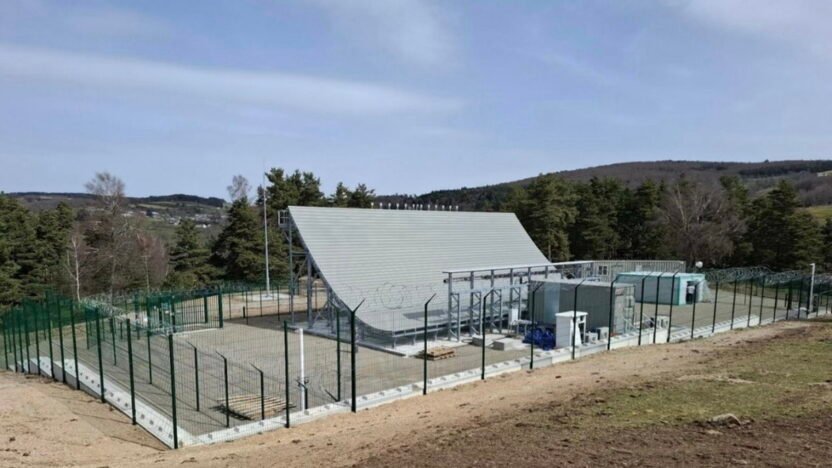
Look Up was founded in 2022 and the first radar it developed in-house became fully operational earlier this year in Lozère, Southern France, where it is providing data for France’s space agency under an agreement running through 2028.
Look Up says SORASYS-1 provides high-precision tracking of objects in LEO, with a target detection capability down to 10 centimeters at full capacity.
The space situational awareness venture raised about $58 million in a funding round last year to support two additional radars in French Polynesia.
Seven radars are ultimately envisaged for ATLAS² to deliver sovereign LEO-tracking capabilities in a domain where most space surveillance is currently provided from the United States.
“ATLAS² is built on this progressive deployment model: we start delivering value from the first operational assets while scaling towards the full seven-radar sovereign network,” Friedling said via email.
“This phased approach allows us to gradually improve revisit rates, orbital coverage and detection accuracy.”
ATLAS² is already an active development program, according to Friedling, leveraging Look Up’s first proprietary radar as well as data from other sources.
“ATLAS² can already provide conjunction assessment, collision-risk analysis and maneuver recommendations independently,” he said.
“What Skynopy enables is the full end-to-end automated execution layer.”
The European Union is contributing about 70% of the 3.4 million euro ($4 million) cost to set up ATLAS² via an accelerator program as more than 15,000 active satellites and hundreds of thousands of debris fragments crowd Earth orbit.