WASHINGTON — Blue Origin has started rebuilding a launch pad severely damaged in a New Glenn explosion less than three weeks ago as it works to resume launches by the end of the year.
Speaking at the VivaTech conference in Paris on June 17, Blue Origin founder Jeff Bezos and its chief executive, Dave Limp, said they were making good progress on returning New Glenn to flight after a May 28 explosion during a static-fire test at Cape Canaveral’s Launch Complex 36.
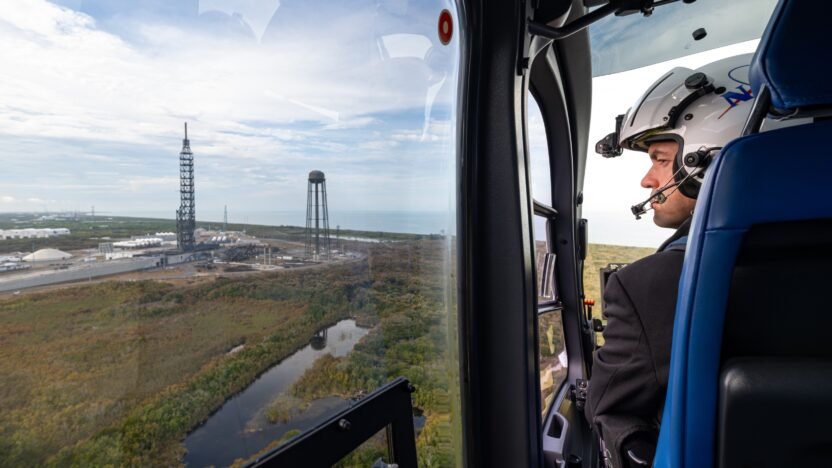
That explosion caused serious damage to the pad, including the collapse of a lightning tower and the destruction of the transporter-erector used to bring the rocket to the pad and raise it to the vertical position. However, Blue Origin concluded the explosion could have been worse.
“It was a gut punch for the whole team,” Bezos said. “But what we’ve learned since then is that we got really lucky. Some of the long-lead items in the launch infrastructure were preserved.”
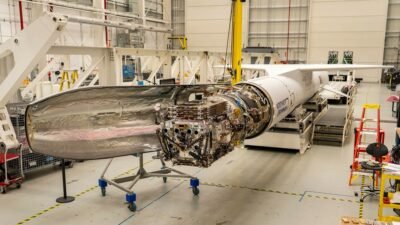
That included a propellant tank farm at the pad, as well as a New Glenn booster used on the previous two launches that was in an integration hangar near the pad. “Various pieces of shrapnel missed the booster,” he said. “There was a lot of good luck in that incident.”
Limp said the company was able to call in a construction crew “just down the road” with 400 pieces of heavy equipment to work on cleaning up the pad. “The pad has been cleared of all debris. It’s amazing how quickly that’s happened,” he said.
“Just yesterday we started the reconstruction” of the pad, he said. “We’re going to fly this year.”
“We’ll fly before the end of the year,” Bezos added.
Neither Bezos nor Limp discussed what caused the explosion or what changes the company will need to make to the vehicle or to pad infrastructure in response. Limp previously said the company would move to an “alternative vertical conop,” or concept of operations, for installing the rocket on the pad, eliminating the need to replace the transporter-erector.
A relatively swift return to flight — many industry observers predicted it would take at least a year to rebuild the pad — would ease some of the pressure on a launch market where demand outstrips supply.
“Demand for launch is insatiable right now,” Bezos said. “We have a tremendous backlog already on our books for launch. Every space launch company has tremendous backlog. We are supply-constrained. We are not demand-constrained.”
That backlog includes missions for NASA as part of the agency’s Artemis lunar exploration campaign using Blue Origin’s Blue Moon lunar lander. The prospect of New Glenn being out of service for an extended time led NASA to consider “decoupling” Blue Moon from its New Glenn launcher.
Limp suggested that decoupling will not be necessary. “Just next year, early in the year, we’ll fly our Mark 1 lander,” he said, a reference to the robotic Blue Moon Mark 1 lunar lander that will fly a mission NASA designated “Moon Base 1” last month.
That will be followed by the launch of a Blue Moon Mark 2 lander prototype in the middle of next year for the Artemis 3 mission, and another Mark 1 lander later in the year carrying NASA’s VIPER lunar rover to prospect for water ice in the south polar regions of the moon.
“The cycle time to the moon, the cadence to the moon, is going to increase very rapidly,” he said.
The company has continued work on the Blue Moon lander while recovering from the New Glenn explosion. That included a recent test of the BE-7 engine that powers the lander, during which the engine fired continuously for 41 minutes, the longest such test ever. The extended test, Bezos said, was needed because “the reliability of this engine is paramount.”
On social media, Limp posted a video of the full 41-minute test. “I’ve come to appreciate boring hotfires,” he wrote.