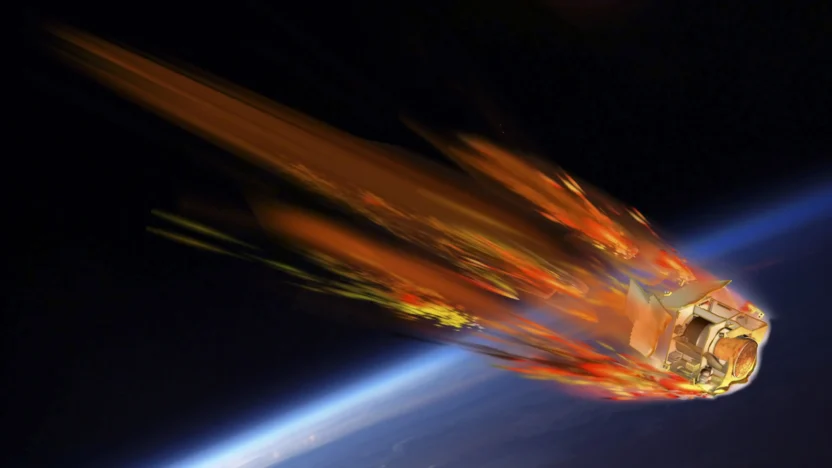
In January 2026 alone, the Federal Communications Commission authorized 15,000 Starlink Gen2 satellites. Starcloud has filed for 88,000 orbital data center satellites. SpaceX has filed for 1 million. There is no atmospheric accounting framework requiring any of these operators to disclose or offset the consequences of their reentries. Recent literature suggests that cumulative stratospheric injection of satellite-derived contaminants — aluminium oxide from structures, and semiconductor-derived elements including silicon, gallium and copper from compute hardware — actually does damage the ozone layer, weakening the polar vortex and causing measurable temperature anomalies in the mesosphere and stratosphere.
At the scale of the deployments we see coming, shouldn’t we be asking if there could be a cost to mass-injection events of materials we know have already had a measurable impact on our ozone? Leaving this question until the damage was already done eventually necessitated the 1987 Montreal Protocol to fix what we never bothered to account for. Every one of these satellites is designed for full demisability, maximizing the injection potential. The design choice to dispose of satellites during reentry presents a coming environmental challenge but also, if properly harnessed, presents an opportunity to further a satellite servicing economy while protecting the environment via policy dictating orbital injection quotas.
If there was a calculated limit on the number of satellites that could be deorbited and disposed of in the upper atmosphere per year and a global “budget” of deorbiting that we knew was safe for our ozone layer, and if satellite operators knew what their allowance of deorbits was when they launched satellites, they would be in a better position to plan for servicing, invest in it and earn credits per serviced satellite. Effectively, operators would be compensated for extending the orbital lifetimes of their assets. Such a policy’s “orbital disposal quotas” could inform how often an operator can dispose of their satellites, while the “credit” system would reward them for servicing their satellites and investing in orbital infrastructure.
The demisable satellite, which would burn up upon reentry at the end of its mission, made sense for an earlier era when the primary threat was defunct assets blocking orbital regimes. But we are rapidly leaving that era behind. In-space servicing technology demonstrations over the last five years have shown that life extension through component replacement and even refueling are increasingly feasible, as documented in recent GAO ISAM technology assessment reporting.
But operators respond to current five-year deorbiting regulations by designing for planned obsolescence, because no market signal yet rewards the alternative. I think there’s a way to price the externality of atmospheric injection via satellite reentries while still rewarding servicing. If we put a price on deorbiting a satellite based on the environmental impact it has at reentry, we create the economic framework for servicing viability. Every avoided reentry is money in an operator’s pocket, an investment in orbital infrastructure and an extension of a key asset’s life.
This is an even more relevant conversation now due to the emerging orbital data center (ODC) satellite market that many companies are heavily investing in — the case for a servicing economy in orbit for this class of satellite is compelling on monetary and environmental grounds. A serviceable ODC satellite with a ten-year operational life requires one launch over a decade; a demisable equivalent requires five. The operator who designs for serviceability does not just reduce atmospheric impact, they also reduce launch costs, extend revenue-generating operational life and position themselves to earn in a credit market that does not yet exist but can be created by policy.
Orbital chemistry credits
The risk to our ozone is real. It is measurable but not yet precisely quantified, and it is growing. If we take inspiration from the carbon trading systems, we end up at an orbital chemistry credits system, with the following mechanisms.
The orbital chemistry credit system would be structured as a performance-based market incentive. Operators who extend satellite service life earn tradeable credits representing the atmospheric value of avoided reentries, and the system would operate through three interlocking elements as follows:
Disclosure: Any operator filing for FCC authorization above 100 satellites submits a Reentry Chemistry Assessment: estimated semiconductor-derived element mass per satellite, expected annual reentry rate and projected atmospheric loading by orbital shell. No new agency is required because the FCC already holds environmental review authority that the GAO has explicitly recommended it exercise for large constellation approvals. Operators calculate from engineering data they already possess; no proprietary architecture or manufacturing detail would be disclosed.
Budget: NOAA and NASA jointly establish an annual atmospheric loading allocation per orbital shell, calibrated to the maximum injection rate at which ozone impacts remain statistically undetectable. In the market’s formative years, operators receive free baseline allocations equivalent to their projected reentry rates, tightening on a published schedule as servicing capacity develops, which is consistent with the phase-in approach that established the EU Emissions Trading System. The budget creates both near-term credit scarcity and a long-term planning horizon: a published atmospheric ceiling that makes the capital case for serviceable fleet design in financial terms.
Credits: Compliance is achieved through three pathways.
- Tier 1: operators whose satellites exceed their disclosed minimum service life earn one avoided-reentry credit per avoided reentry, tradeable on the open market.
- Tier 2: operators exceeding their annual budget purchase credits from Tier 1 earners at market price.
- Tier 3: where credit supply is insufficient, operators contribute to a US ISAM Development Fund at a regulated price cap — a pay-for-success capital pool disbursed against demonstrated servicing milestones.
The fund would close automatically when a defined market maturity threshold is reached. Across all three pathways, the credit system actively accelerates market maturation: injecting capital, creating demand signals and establishing the financial architecture on which an orbital servicing industry can be built.
This is not a tax, nor a prohibition; it’s an invitation by design. Operators may still design for demisability, they’ll just participate as credit buyers or fund contributors rather than penalized actors. They’ll capitalize the very infrastructure that will eventually make their satellites serviceable cheaper, faster and with more competitive technology. Every participant in the system is contributing to a U.S. orbital servicing industry that did not previously exist.
When you apply the credit system math to a single fleet, you can see why it would be attractive. Starcloud’s FCC filing covers 88,000 orbital data center satellites with a radiation-limited GPU compute life of approximately two years. At steady state, that constellation implies 44,000 reentries per year. A serviced equivalent, satellites with active component replacement extending operational life to ten years, implies 8,800 reentries per year. The delta is 35,200 avoided reentries annually. At a conservative credit price of $50,000 per avoided reentry, full servicing of this single constellation creates a credit market worth $1.76 billion per year. That market is earned by whoever develops the servicing capability — not extracted from Starcloud, but generated by the atmospheric value of keeping satellites operational longer.
This market does not materialize overnight, obviously; the credit supply depends on servicing capability that will develop over years, not months. That’s why the framework would pair market incentives with phased baseline allocations and the ISAM Development Fund to capitalize the transition period.
Per-satellite economics show how an operator could see it as economically viable as well. An ODC satellite serviced to a ten-year operational life would earn eight avoided-reentry credits against a two-year demisable baseline, which is $400,000 in credit revenue per satellite from credits alone, before any consideration of extended compute revenue. Every operator in the system would now have a direct financial incentive to design for serviceability.
Policy like this can be actioned with existing authorities. The FCC can exercise existing environmental review authority for large constellation approvals, and the NOAA and NASA can start atmospheric budget modelling for orbital shells.
It’s doable, and the window for preemptive governance on this issue is closing. The Montreal Protocol has taken 40 years to address ozone damage caused by the generation that created it. If we fail to build the servicing infrastructure now, the megaconstellation era we are racing to achieve will impose the same generational cost on the orbital environment — and the operations that depend on it. Governance ought to be established that plans no harm, and creates a market that does good.
Savannah McNamara is an information developer authoring CPU architecture documentation at Arm Ltd, and also an independent researcher working on operator-independent satellite health measurement systems, modelling atmospheric injection at satellite reentry and space policy.
SpaceNews is committed to publishing our community’s diverse perspectives. Whether you’re an academic, executive, engineer or even just a concerned citizen of the cosmos, send your arguments and viewpoints to opinion (at) spacenews.com to be considered for publication online or in our next magazine. If you have something to submit, read some of our recent opinion articles and our submission guidelines to get a sense of what we’re looking for. The perspectives shared in these opinion articles are solely those of the authors and do not necessarily represent their employers or professional affiliations.