
WASHINGTON — House and Senate appropriators criticized a NASA budget proposal for fiscal year 2027 that includes significant cuts, suggesting they may instead use last year’s spending bill as a guide.
In back-to-back hearings by the House Appropriations Committee’s Commerce, Justice and Science (CJS) Subcommittee on April 27 and its Senate counterpart April 28, members of both parties told NASA Administrator Jared Isaacman that the $18.8 billion proposed for his agency in 2027, a 23% cut from 2026, was insufficient.
“After the success and momentum NASA has built up over the last year, it’s disappointing to see that request,” Rep. Hal Rogers, R-Ky., chairman of the House CJS appropriations subcommittee, said in his opening remarks, citing a “space race” with China to return humans to the moon. “This is a critical time for investment in NASA.”
Rep. Grace Meng, D-N.Y., ranking member of the subcommittee, noted the budget proposal would cancel more than 50 science missions in development or extended operations. “House Democrats will once again lead the fight to make sure these budget proposals never become law.”
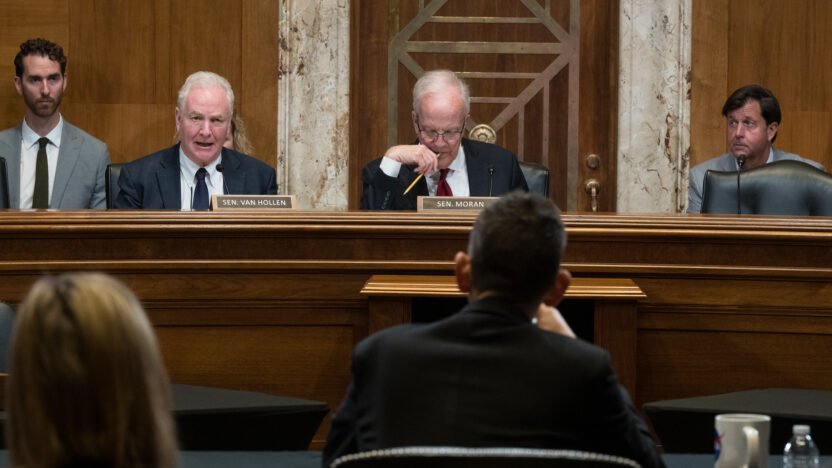
The leadership of the Senate CJS subcommittee offered similar sentiments. “I have significant concerns about the FY27 budget request,” said Sen. Jerry Moran, R-Kan., chairman of the subcommittee, who previously said he opposed proposed cuts. “A budget that prioritizes exploration at the expense of science, technology and other core missions risks undermining the very foundation that makes those exploration efforts possible.”
“I think you well know the fiscal year 2027 Trump budget proposal is anything but ambitious. It is shortsighted,” said Sen. Chris Van Hollen, D-Md., ranking member of the subcommittee. “It would be a disaster for the NASA mission.”
At both hearings, like the April 22 hearing on the budget proposal by the House Science Committee, members peppered Isaacman with questions about cuts to science missions and the closure of the agency’s education office. Isaacman argued that the budget proposal provided sufficient funding for its exploration priorities while seeking efficiencies in areas like science.
His arguments did not appear to win over appropriators. Sen. Jeanne Shaheen, D-N.H., called the agency’s budget request for science “abysmal” and singled out sharp cuts in heliophysics, whose budget would be reduced by more than 50% in the budget proposal.
“I’m a huge fan of heliophysics,” Isaacman responded, but argued that commercial capabilities with satellite constellations could enable much less expensive missions, comparing it to the reduction in launch costs enabled by reusable rockets.
“I’m not convinced,” Shaheen said.
Not everyone on the appropriations subcommittees was opposed to the cuts. Rep. Andrew Clyde, R-Ga., praised Isaacman for a budget proposal that “prioritizes NASA’s most important missions, reduces redundancies and ensures that critical programs remain on time and on budget, all while saving taxpayers an amazing more than $5 billion.”
Critics of the budget, though, did not blame Isaacman for the cuts, but instead the White House and its Office of Management and Budget. “This would be a very different hearing if I believed the budget request from the administration reflected your best judgment,” Van Hollen said. “To me, this is a carbon copy of what OMB submitted last year, and I really think it’s a disgrace.”
Besides questions about the 2027 budget proposal, appropriators at both hearings complained that NASA was late in submitting its fiscal year 2026 operating plan, which provides details about how it will spend the funding appropriated in the current fiscal year. Some noted that the operating plan for fiscal year 2025 was not released until this March, months after the end of the fiscal year.
Isaacman told appropriators that NASA had submitted its operating plan to the White House earlier this month, and he expected it to be sent to Congress next week.
“We can’t proceed until we’ve got the plan,” Rogers said.
However, House appropriators are proceeding with their CJS spending bill, with a markup by the subcommittee scheduled for April 30. The full committee will mark up the spending bill May 13.
Senate appropriators have not released their schedule for marking up a CJS spending bill. “I would guess our work will begin with FY26 as a starting point, a baseline,” Moran said. He asked Isaacman if that bill underemphasized or overemphasized any programs.
“If I had any one request,” Isaacman responded, “it’s just the flexibility with respect to the programs.” Appropriations bills today, he said, are longer and more specific than those from the Apollo era of the 1960s. “The flexibility to be able to react in an environment that’s certainly a fast-moving ballgame against a very motivated competitor, I think is important.”