TAMPA, Fla. — Starcloud has ordered optical terminals from SpaceX to use Starlink as a global data-relay network for its future orbital data centers, deepening ties with the company it is counting on to launch full-size spacecraft.
The Redmond, Washington-based startup announced a contract May 26 for more than 50 Starlink Mini Lasers, enough to equip at least 25 satellites with two terminals each as part of a constellation that ultimately envisions 88,000 orbital data centers.
Financial details were not disclosed.
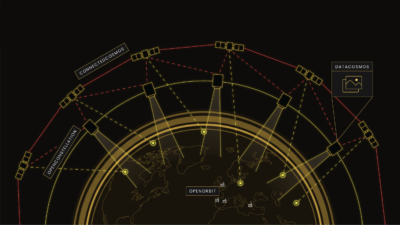
The terminals would connect Starcloud satellites directly into Starlink’s low Earth orbit mesh network, bypassing bandwidth-constrained ground stations.
Philip Johnston, Starcloud’s co-founder and CEO, told SpaceNews the lasers will be installed on all future planned satellites starting with Starcloud-2, which is slated to launch on a SpaceX Falcon 9 in January.
The 450-kilogram spacecraft is set to be the venture’s first to run commercial cloud workloads. It is designed to generate about eight kilowatts of power, around 100 times more than the 60-kilogram Starcloud-1 demonstrator SpaceX deployed in November.
AI infrastructure provider Crusoe is among early customers for Starcloud-2, with Starcloud also counting Nvidia and cloud providers AWS and Google as partners.
Meanwhile, SpaceX’s Starship is being lined up to deploy Starcloud-3, a three-ton, 200-kilowatt-class spacecraft that would support AI inference and training workloads uplinked from Earth, addressing the power, land, water and other constraints data centers face on the ground.
Boosting early services
Johnston has estimated that Starship could be ready to deploy customer payloads in the mid- to late-2028 timeframe.
However, he said the venture can “tread water” until then by launching Starcloud-2-class satellites on Falcon 9 for cloud and edge-computing customers, as well as hosted payloads from defense and Earth observation users.
Starcloud said Starlink’s optical mesh would support near-term applications including real-time weather forecasting, wildfire detection and Earth observation analytics, where sensor data collected in orbit needs to be processed and distributed quickly.
The Starlink Mini Lasers are also compatible with Starcloud-3, which Johnston said he expects to account for most of the satellites covered by the initial terminal order.
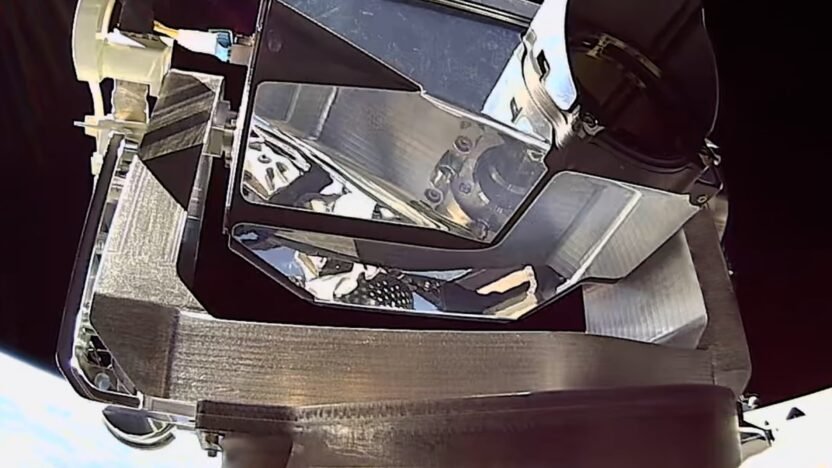
Like Starcloud-2, a Starcloud-3 would carry a pair of the terminals, each designed to provide up to 25 gigabits per second of inter-satellite connectivity at distances up to 4,000 kilometers, with higher speeds possible over shorter ranges.
While 25 Gbps is modest by terrestrial standards, Johnston said it is substantial for a 200-kilowatt orbital node and would provide more external connectivity per watt than the average ground-based data center.
Relying on Starlink for high-bandwidth optical connectivity could also reduce the complexity for satellites Starcloud is building in-house, although the two-year-old venture still faces significant power generation, thermal management and radiation-tolerant computing challenges.
A source recently confirmed Starcloud is seeking to raise at least $200 million for the constellation in a deal that would double the $1.1 billion it achieved in March, following a $170 million funding round.
Starlink data relay services
Vast announced in 2024 that its Haven-1 commercial space station would use Starlink laser links the following year, although the outpost has since slipped to no earlier than the first quarter of 2027.
The first Starlink-integrated Halo satellite from manufacturer Muon Space is also slated for deployment early next year.
And the Starlink network is a core part of SpaceX’s own plans for up to a million orbital data centers, which the company aims to begin deploying as soon as 2028.
Johnston said he expects SpaceX to focus mainly on internal workloads for xAI and Tesla, while Starcloud aims to provide infrastructure and energy-as-a-service for customers seeking to run their own computing capacity in orbit.