
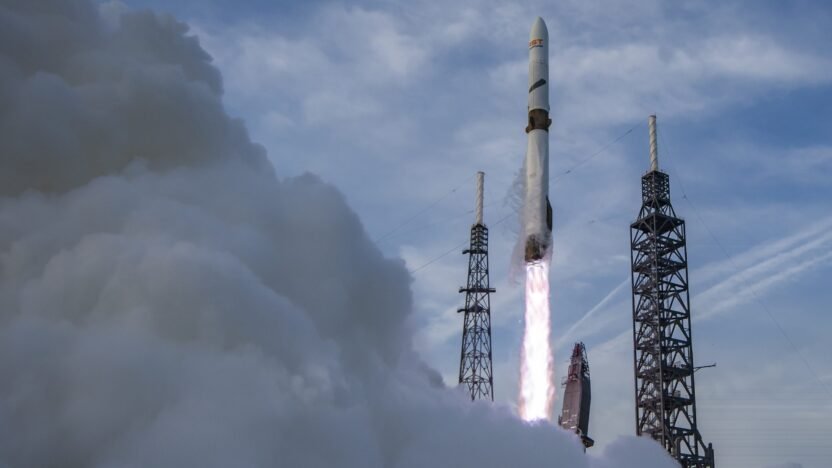
WASHINGTON — Blue Origin’s chief executive says damage to its New Glenn launch pad is not as bad as feared and that the vehicle could return to flight by the end of the year.
In an update late June 1, Dave Limp said key infrastructure at Launch Complex 36, including tanks for storing liquid oxygen, hydrogen and methane, is “in good shape” after the May 28 explosion of a New Glenn rocket on the pad during a static-fire test.
“This is good luck because these are very long lead items,” he said of the tanks. The New Glenn booster used on the rocket’s second and third flights and three upper stages, stored in a horizontal integration facility not far from the pad, “also look good.”
The pad, though, did suffer extensive damage. A lightning tower was destroyed, along with the rocket’s transporter-erector. The main tower at the pad suffered structural damage, with metal beams bent out of place.
“The big support tower is damaged, but it can be repaired in place rather than torn down and replaced,” Limp stated. The company, he said, was already considering “an alternative vertical conop,” or concept of operations, for putting the rocket on the pad in place of the transporter-erector. “We’ll now go directly to that; so we don’t need a new transporter-erector.”
He concluded all that work, along with the investigation into the explosion itself, could be done in the next seven months. “We will fly again before the end of this year,” he said.
That would be a much faster schedule than similar incidents. SpaceX took 15 months to rebuild Space Launch Complex 40 at Cape Canaveral after a Falcon 9 exploded during preparations for a static-fire test there in September 2016. Launch Pad 0A at Virginia’s Wallops Island spaceport was heavily damaged when an Antares rocket malfunctioned seconds after liftoff and crashed next to the pad in October 2014, taking about a year to repair.
Limp’s comments come after some confusion about NASA’s assessment of how long pad repairs would take. CNBC reported June 1 that NASA Administrator Jared Isaacman, speaking at a conference organized by the television network, said it was “within the realm” of possibilities that the pad might not be ready until 2028.
Isaacman, in a later social media post, said his comments were misinterpreted. “The question was about the timing of the Moon Base and recent lunar rover awards,” he wrote. “I was pointing out that those missions are not until 2028, which should be well within what is possible for pad recovery.”
NASA announced May 26 that it selected Blue Origin’s Blue Moon Mark 1 lander for a pair of missions to deliver lunar rovers being built by Astrolab and Lunar Outpost. Those would be the third and fourth missions by that lander for NASA, after the “Moon Base 1” lander mission that had been scheduled to launch this fall and the VIPER rover mission awarded to Blue Origin last September and planned for 2027.
Blue Moon, in both its Mark 1 robotic version and Mark 2 crewed version, is designed to launch on New Glenn. Delays in getting New Glenn and its launch pad back in service would affect both the robotic missions as well as Artemis 3, a mission NASA plans to launch in mid-2027 in which a crewed Orion spacecraft will dock with both Blue Moon Mark 2 and SpaceX’s Starship in low Earth orbit.
Speaking at a June 2 National Academies meeting, Lori Glaze, acting associate administrator of exploration systems development at NASA, said it was still too early to understand how the New Glenn accident might affect plans for Artemis 3. NASA plans to provide an update on Artemis 3 on June 9, including announcing the crew for the mission.
“We are working very closely with Blue,” she said. “We’ll have more information on how we see proceeding, but, as for now, we are still pushing very strongly on the Artemis 3 mission.”