
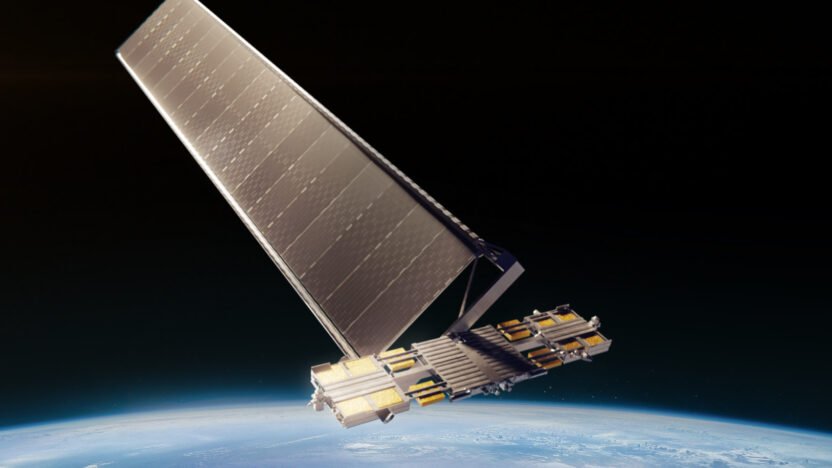
TAMPA, Fla. — Muon Space announced a Starship-class satellite platform June 3 designed from the ground up to meet the demands of the emerging orbital data center market, with an initial launch slated for 2028 after securing customers.
The Condor-Ultra platform would initially offer 20 kilowatts of baseline power and more than 18 square meters of nadir payload area, with Starlink Mini Lasers from SpaceX to use its broadband constellation for inter-satellite data relay.
Greg Smirin, president of the five-year-old Californian satellite maker, said “Condor-Ultra is a different magnitude entirely” than the 500-kilogram XL platform announced last year, at three times the weight and five times the power of what was previously its largest and most powerful spacecraft.
From there, he said Condor-Ultra is designed to scale depending on mission requirements to 100 kilowatts of power, with “native Starship stackability” for deployments of hundreds to thousands of satellites at some point after the rocket enters service.
Muon is set to open a new production facility in San Jose, California, later this month to expand its manufacturing footprint by 10 times and bring capacity to up to 500 satellites per year.
“The economics of Condor-Ultra are specifically designed to make that ramp viable,” Smirin said via email.
“Configurations for today’s medium-lift vehicles, including Falcon 9 and Rocket Lab’s Neutron, are available now, and Starship stackability dramatically expands the opportunity, reducing per-satellite launch costs at scale.”
Vertical integration is another key part of Muon’s strategy for accelerating production, which includes propulsion following the acquisition last year of startup Starlight Engines.
According to Smirin, Muon controls 95% of its spacecraft production in-house, with limited dependence on outside suppliers.
Condor-Ultra is also being designed to integrate next-generation computing hardware, including NVIDIA’s Space-1 Vera Rubin Module, a space-focused system for AI inferencing.
The first XL satellite is slated to launch in 2027 for Hubble Network, a Bluetooth connectivity startup. Muon also plans to test Starlink Mini Lasers in orbit for the first time in a separate mission that year.
In 2028, Smirin said the Condor-Ultra pathfinder would fly a complete production-configuration platform, rather than serving as a traditional technology demonstrator.
SpaceX, Starcloud, Cowboy Space and others that have proposed large-scale orbital data center constellations have said they are looking to build them in-house, touting their own vertical integration benefits.
However, as the market matures and performance requirements intensify, Smirin said he believes Muon’s vertical integration investments “will prove more compelling than every operator bearing the full cost and complexity of building their own hardware, software, operations and satellite infrastructure from scratch.”
He said Condor-Ultra is purpose-built for orbital data center and communications missions — “and we have customers across all of these categories.”
He declined to disclose the customers, but said “the 2028 pathfinder is not a speculative platform. It is being built to meet real mission requirements from customers who are already engaged.”