HELSINKI — Chinese commercial launch startup Nayuta Space has completed consecutive Pre-A financing rounds to support development of its unconventional Xuanniao-R rocket concept.
Nayuta Space secured an undisclosed amount of financing through Pre-A1 to Pre-A3 rounds, the company announced April 24. The funding will go towards static ignition of the second stage of the Xuanniao-R launch vehicle, scaled-down aerodynamic deceleration flights, wind tunnel campaigns and related recovery technology testing.
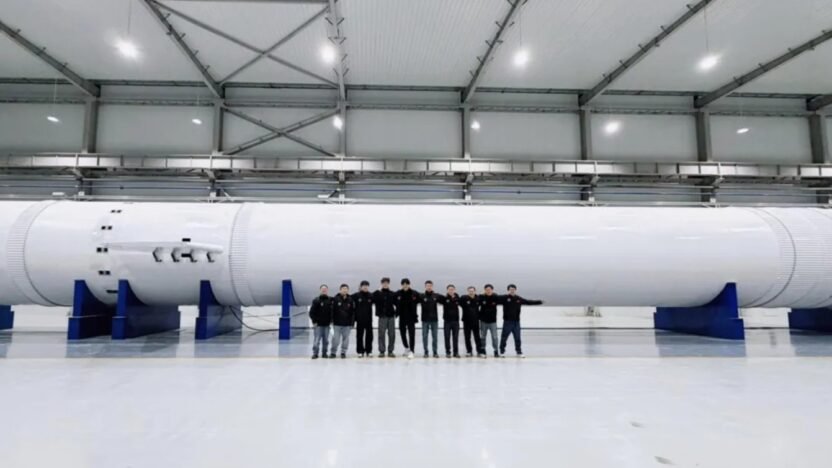
The two-stage, 70-meter-long, 3.8m-diameter Xuanniao-R launcher features an unconventional aerodynamic deceleration and horizontal landing (ADHL) approach to reusability, with Nayuta targeting a debut test flight of the Xuanniao-R in the first half of 2027.
The test flight will focus on ensuring successful insertion of a payload into orbit and conducting controlled recovery tests upon return to collect relevant data and iterate on the aerodynamic deceleration and recovery technology, according to the company statement.
Most Chinese commercial launch companies, such as Landspace, Space Pioneer, Deep Blue Aerospace, Galactic Energy and iSpace, are following the Falcon 9-style vertical takeoff, vertical landing approach, while state-owned CASC is also attempting both VTVL and a net capture system.
Nayuta earlier planned a chopstick-style recovery, similar to that used by SpaceX’s Starship and adopted by Chinese startups Cosmoleap and Astronstone, both of which have also recently secured fresh funding. These companies, along with Nayuta Space, appear to be pursuing more aggressive reusable launch architectures rather than incremental development pathways.
Nayuta Space’s stainless steel rockets are named Black Bird, referring to a creature from Chinese mythology rather than the common blackbird. The Black Bird-R first stage will use 13 Canglong-1 methane-liquid oxygen engines developed by Beijing Aerospace Propulsion Technology Co. Ltd., a commercial rocket engine maker founded in 2018.
While Nayuta Space claims its aerodynamic deceleration approach can reduce the dependence on a launcher engines’ reignition, propulsive braking and high-precision control capabilities for vertical recovery, the approach will demand new aerodynamic structures, bringing challenges including increased weight and complexity. The size of the launcher, the novel and unproven approach and uncertain levels of funding suggest the 2027 timeline for a debut flight is very ambitious.
China is seeing a proliferation of new commercial launch vehicles, in part due to strong central government backing for commercial space, demand for launch from megaconstellation projects, and support for companies and infrastructure at the provincial and local levels.